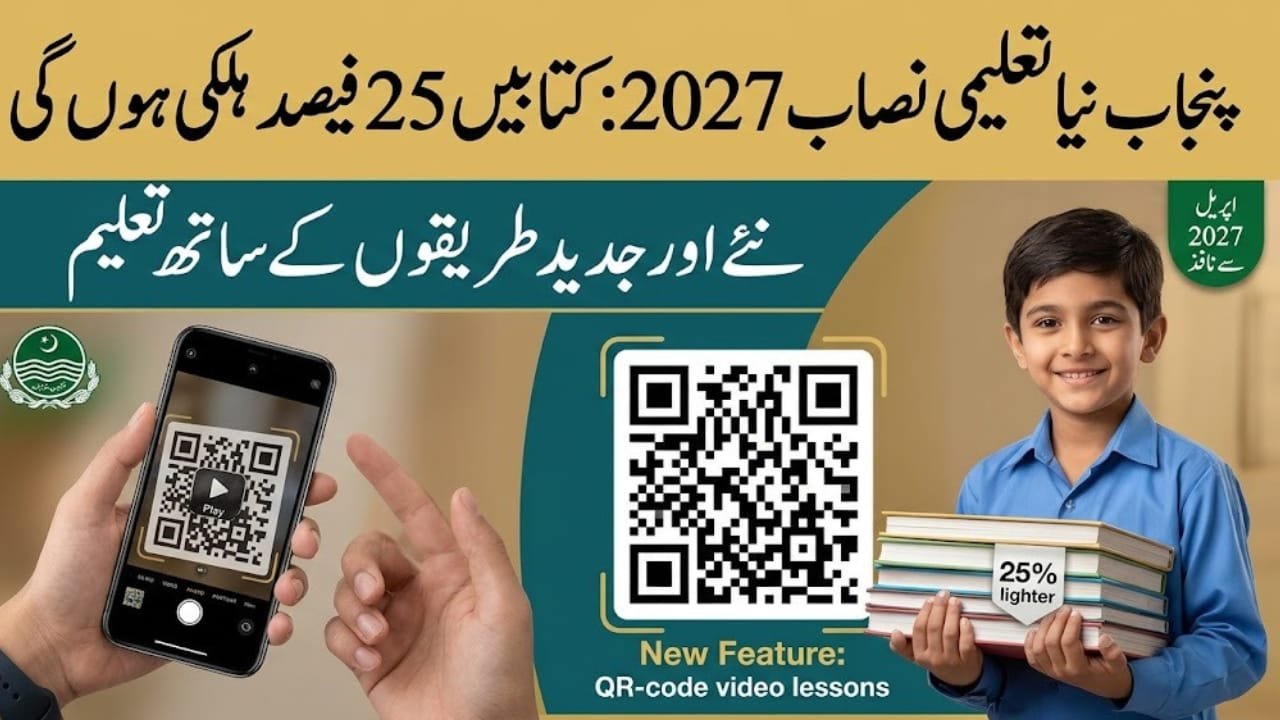
Punjab Introduces New School Curriculum
Punjab New Curriculum 2027 will bring major changes to primary education, with the provincial government planning to reduce textbook volume by 25% and introduce modern learning methods. The revised curriculum aims to make schoolbags lighter and move students away from traditional rote memorisation. According to recent reports published in November 2026, the new curriculum will cover Early Childhood Care and Education (ECCE) to Grade 5, with implementation planned for the academic session starting in April 2027. Students will also benefit from QR-code-based video lessons and improved classroom learning.
Quick Information Table
| Information | Details |
|---|---|
| Initiative | New School Curriculum 2027 |
| Province | Punjab, Pakistan |
| Relevant Authority | PECTAA |
| Classes Covered | ECCE to Grade 5 |
| Expected Implementation | April 2027 |
| Textbook Reduction | 25% |
| New Feature | QR-code video lessons |
| Main Objective | Concept-based learning |
Overview of Punjab New Curriculum 2027
The Punjab government has approved a revised curriculum to improve the quality of primary education across the province. The initiative focuses on reducing unnecessary textbook content while helping children understand subjects more effectively.
The Punjab Education Curriculum, Training and Assessment Authority (PECTAA) developed the revised curriculum. It covers Early Childhood Education, English, Mathematics, Urdu and Social Studies.
Instead of encouraging students to memorise lengthy lessons, the revised syllabus aims to strengthen conceptual understanding, creativity and practical learning.
Latest Updates About the New School Curriculum
According to reports published on November 4, 2026, the government plans to introduce the revised curriculum from April 2027.
The major announced changes include:
- 25% lighter textbooks: The volume of textbooks will be reduced to decrease students’ academic burden.
- QR-code technology: Textbooks will include QR codes that provide access to relevant video lessons.
- Cambridge assessment: The revised curriculum has reportedly been sent to Cambridge International Education for assessment and comparison.
- Teacher training: Teachers will receive training to help them teach the revised syllabus.
- Digital education: The government is also working towards introducing artificial intelligence education from Class 1 to Class 12.
Officials have indicated that the final curriculum content is expected in December 2026, followed by textbook printing in January 2027. The Express Tribune+2
Eligibility Criteria
The new curriculum is an education reform, not an individual financial assistance programme. Therefore, students do not need to submit applications or meet income requirements.
Who Will Benefit?
- Children enrolled in ECCE and primary classes up to Grade 5.
- Students studying in Punjab’s government schools.
- Teachers responsible for delivering the revised curriculum.
The implementation details for private schools and other grade levels have not been fully confirmed.
Benefits of the New Curriculum
The revised education system is expected to offer several benefits to students, parents and teachers.
- Lighter schoolbags: Reducing textbook volume by 25% will help decrease the number of pages students need to carry and study.
- Better understanding: Concept-based teaching will encourage students to understand lessons instead of memorising information.
- Digital learning: QR codes will provide access to educational videos and additional explanations.
- Improved teaching: Teacher training will help educators adopt modern classroom techniques.
- Reduced academic pressure: Simplified textbooks may help children manage their studies more comfortably.
- Technology awareness: Planned AI education will introduce students to emerging technologies.
Required Documents
No documents are required to register for the new curriculum because the government has not announced any student registration process.
Parents should keep their children’s existing school records and follow instructions issued by their respective schools.
Registration Process
There is no separate online or offline registration process for students.
The new curriculum is planned for implementation through the education system. Parents should follow these steps:
- Contact their child’s school for information about the revised syllabus.
- Wait for the official textbook list for the 2027 academic session.
- Follow the school’s instructions regarding new textbooks.
- Check whether the school provides access to QR-based learning resources.
- Contact the relevant education authorities if further clarification is needed.
Parents should avoid purchasing new textbooks before schools announce the officially prescribed book lists.
Frequently Asked Questions (FAQs)
1. When will Punjab New Curriculum 2027 start?
The revised curriculum is scheduled for implementation from April 2027, at the beginning of the new academic session.
2. How much will textbook volume be reduced?
The government plans to reduce textbook volume by 25% to decrease students’ academic burden.
3. Which classes will follow the new curriculum?
The first phase will cover Early Childhood Care and Education (ECCE) to Grade 5.
4. Will the new textbooks include QR codes?
Yes. According to officials, the revised textbooks will include QR codes that students can scan to access educational video lessons.
5. Do parents need to register their children?
No. The government has not announced any separate registration requirement or application process for this curriculum.
Conclusion
Punjab’s education reforms aim to make primary education more accessible, engaging and less stressful for young learners. The planned 25% reduction in textbook volume, QR-code-based video lessons and focus on conceptual understanding could change how children learn in classrooms. However, successful implementation will depend on proper teacher training and the cooperation of schools and parents. Punjab New Curriculum 2027 is expected to begin in April 2027. Parents should wait for official textbook lists and further instructions before making purchases for the new academic session.