Masjid Quba, the First Mosque in Islam | Complete History, Fazilat & Visitor Guide (2026)
Masjid Quba, also written as Masjid Qubaa holds a place of unmatched reverence in the heart of every Muslim. Located just 5 kilometres southwest of Masjid-e-Nabawi in Madinah Al-Munawwarah, Saudi Arabia, the Quba Mosque is universally recognized as the first mosque ever built in the history of Islam.
When Prophet Muhammad ﷺ migrated from Makkah to Madinah in 622 CE (1 Hijri), the very first thing he did upon arriving was lay the foundation of this sacred mosque. Before even entering the city of Madinah, He ﷺ stopped at the settlement of Quba and, together with his blessed Companions (Sahaba), constructed what would become the first house of worship in the new Islamic era.
For Muslims visiting Madinah whether for Hajj, Umrah, or ziyarat visiting the Quba Mosque is not just a sentimental experience. It carries immense spiritual reward that is directly backed by authentic Hadees.
Masjid Quba History
Understanding Masjid Quba history is essential to appreciating why this mosque holds such a special place in Islamic heritage.
The Hijrat and the Foundation of Quba Mosque
In the 13th year of Prophethood (622 CE), Prophet Muhammad ﷺ embarked on the historic migration (Hijrat) from Makkah to Madinah, accompanied by his closest companion, Hazrat Abu Bakr Siddiq RA. After days of travel through the desert, the Prophet ﷺ arrived in the area of Quba, a settlement on the outskirts of Madinah on the 8th of Rabi-ul-Awwal.
He ﷺ stayed in Quba for approximately 14 days at the home of Hazrat Kulthoom bin Hadm RA. During this period, the Prophet ﷺ himself participated in laying the foundation stones of the mosque. The Sahaba worked alongside him, carrying stones and building the walls of what would become the world’s very first mosque dedicated to the worship of Allah.
This was not merely a building, it was the physical symbol of a new era for Islam, a declaration that the Muslim Ummah now had its own home, its own community, and its own place of worship.
What Does the Quran Say About Masjid Al Quba?
The significance of Masjid Al Quba is not just a matter of historical record, it is enshrined in the Holy Quran itself.
In Surah At-Tawbah, Ayat 108, Allah ﷻ says:
“A mosque founded on righteousness (taqwa) from the very first day is more deserving that you stand in it (for prayer). Within it are men who love to purify themselves, and Allah loves those who purify themselves.”
Many leading scholars of Tafseer, including Ibn Katheer and Imam Qurtubi, have affirmed that this ayah refers specifically to Masjid Quba, making it the only mosque in the world that has been directly praised in the words of Allah ﷻ.
This Quranic distinction alone makes the Quba Mosque unlike any other place of worship on earth.
The Role of the Sahaba in Building Masjid Qubaa
The construction of Masjid Qubaa was a collective effort by the Muhajireen (migrants from Makkah) and the Ansar (helpers from Madinah). Among those who played an active role:
- Hazrat Abu Ayub Ansari RA hosted the Prophet ﷺ and contributed to the early construction
- Hazrat Ali ibn Abi Talib RA joined the Prophet ﷺ three days later from Makkah and participated in the construction
- Hazrat Ammar ibn Yasir RA carried the heaviest loads of stones and was praised by the Prophet ﷺ for his dedication
- The Ansar of Banu Amr ibn Awf, the local tribe that actively supported the construction
This communal spirit of building Masjid Quba set the tone for the entire Islamic civilization that would follow.
The Qibla Change at Masjid Quba
One of the lesser-known but historically important facts about Masjid Quba history is that when it was first constructed, the Qibla (direction of prayer) was oriented toward Bait-ul-Muqaddas (Jerusalem). Later, when the command from Allah ﷻ came to change the Qibla toward the Kaaba in Makkah, the mosque was accordingly reoriented.
This detail reminds us that Masjid Quba was not just present at the beginning of the Madinan era, it was a witness to one of the most significant divine commands in Islamic history.
The Spiritual Reward of Praying at Quba Mosque
If you ask any scholar or guide in Madinah why the Quba Mosque must be visited, the answer will almost always begin with this authentic Hadees:
“Whoever purifies himself at home, then comes to Masjid Quba and prays two rakat there, will have the reward equal to that of performing Umrah.”
Sunan Ibn Majah, classified as Sahih
This single Hadees has made Masjid Al Quba one of the most visited sites in all of Madinah. Performing two rakat nafl (voluntary prayer) here, after making wuzu at home, is equivalent in reward to a complete Umrah, a pilgrimage that involves traveling hundreds or thousands of kilometres for most Muslims in the world.
Prophet Muhammad ﷺ Visited Every Saturday
Another remarkable fact: the Prophet ﷺ himself would visit Masjid Quba every Saturday, travelling on foot or by camel, and would pray two rakat there. This Sunnah is recorded in both Sahih Bukhari and Sahih Muslim, making a weekly visit to the Quba Mosque a well-established Sunnah of the Prophet ﷺ.
Architecture and Renovation of Masjid Al Quba
The Masjid Al Quba we see today is a far cry from the simple, modest structure built in 622 CE. Over fourteen centuries, the mosque has undergone numerous expansions and renovations:
| Era | Key Development |
|---|---|
| 622 CE | Original construction by Prophet ﷺ and Sahaba |
| 7th Century CE | First expansion under the Caliphs |
| Umayyad Era | Formal minaret added |
| Ottoman Era | Major structural renovation |
| 1986 CE | Comprehensive modern reconstruction by Saudi government |
| 2010s–Present | Further capacity expansion and beautification |
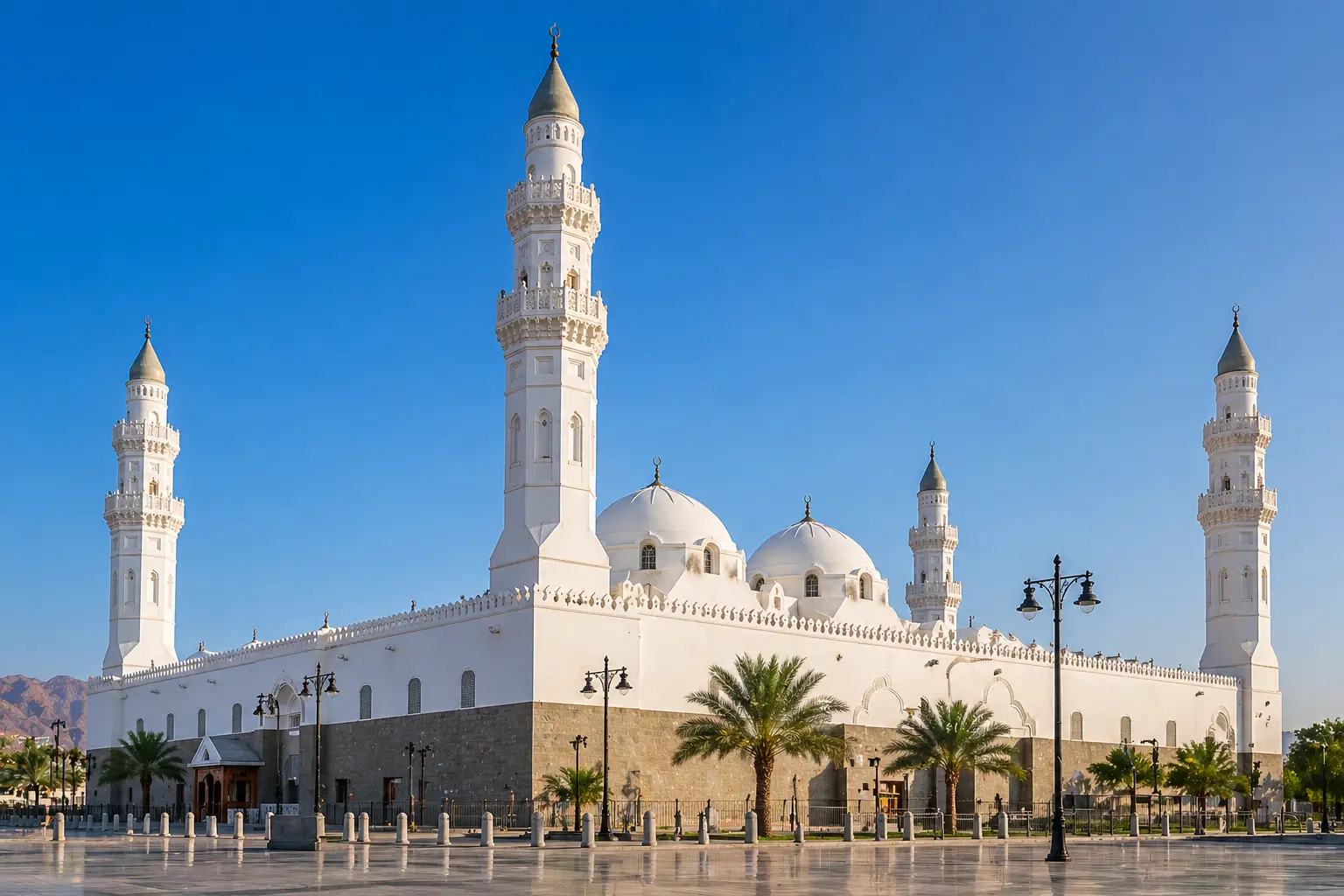
The current mosque, rebuilt and expanded significantly in 1986 under the supervision of architect Abdel Wahed El-Wakil, is one of the most architecturally elegant mosques in Madinah. It features:
- 4 minarets reaching 47 metres in height
- 56 small domes and a central large dome
- Capacity for over 20,000 worshippers
- Separate, well-maintained sections for women
- Air-conditioned prayer halls
- Ablution (wuzu) facilities for men and women
- Beautiful marble flooring and Arabic calligraphy throughout
The mosque complex also includes a garden, library, and an administrative centre for Islamic education.
Location of Masjid Qubaa
Masjid Qubaa is located about 6 kilometers (around 4 miles) south of Masjid al-Haram in Madinah. There is a walkway that connects Masjid al-Haram to Masjid Qubaa. Many visitors love to take a walk along this path, especially on Saturday, as it’s known that the Messenger ﷺ would visit Masjid Qubaa every Saturday.
Masjid Qubaa is a must-visit for anyone who travels to Madinah. Whether you are a history lover, someone seeking more reward, or just curious to see where it all began, this mosque has something special to offer. Next time you’re in Madinah, make sure to add Masjid Qubaa to your itinerary.
Step-by-Step Guide: How to Perform Ziyarat of Masjid Quba
To get the full spiritual benefit of visiting the Quba Mosque, follow this simple guide:
For Women: A well-maintained and fully separate section is available for women, with dedicated entrance, prayer area, and ablution facilities.
Masjid Quba vs Nearby Mosques, Quick Comparison
| Feature | Masjid Quba | Masjid-e-Nabawi | Masjid-e-Qiblatayn |
|---|---|---|---|
| Historical First | First mosque in Islam | Second mosque built | Mosque of the two Qiblas |
| Quranic Mention | Yes (Surah At-Tawbah 9:108) | Indirect references | No direct mention |
| Special Reward | 2 rakat = Umrah reward | Multiplied rewards | Historical significance |
| Distance from City | 5 km from Nabawi | City centre | ~4.5 km northwest |
| Women’s Section | Yes | Yes | Yes |
Frequently Asked Questions (FAQ) About Quba Mosque
Where is Masjid Quba located?
Masjid Quba is located in the Quba district of Madinah Al-Munawwarah, Saudi Arabia, approximately 5 km southwest of Masjid-e-Nabawi.
What is the significance of Masjid Al Quba in Islam?
Masjid Al Quba is the first mosque ever built in Islam. It was constructed by Prophet Muhammad ﷺ and his Companions in 622 CE upon his migration to Madinah. It is also mentioned in the Holy Quran in Surah At-Tawbah (9:108) and offers the reward of Umrah for two rakat nafl prayed there.
What reward do you get for praying at Quba Mosque?
According to an authentic Hadees, anyone who performs wuzu at home and then prays two rakat at the Quba Mosque receives a reward equal to that of performing a full Umrah.
Is Masjid Quba mentioned in the Quran?
Yes. Most Islamic scholars agree that Surah At-Tawbah, Ayat 108 refers directly to Masjid Qubaa, describing it as a mosque “founded on righteousness (taqwa) from the very first day.”
Can women visit Masjid Quba?
Yes. The Quba Mosque has a fully separate, comfortable section for women with its own entrance, prayer hall, and ablution facilities.
How old is Masjid Quba?
Masjid Quba was built in 622 CE (1 Hijri), making it over 1,400 years old, the oldest mosque in the history of Islam.
What is the capacity of Masjid Quba today?
The current structure of the Quba Mosque, after modern renovations, can accommodate more than 20,000 worshippers at a time.
Is Masjid Quba open 24 hours?
Yes, the Quba Mosque is open 24 hours, 7 days a week throughout the year.
How far is Masjid Quba from Masjid-e-Nabawi?
The Quba Mosque is approximately 5 kilometres from Masjid-e-Nabawi. By taxi it takes around 10–15 minutes; on foot along the dedicated walking path, approximately 45–60 minutes.
Why did the Prophet ﷺ visit Masjid Quba every Saturday?
It was the personal Sunnah of Prophet Muhammad ﷺ to visit Masjid Quba every Saturday, either walking or riding, and to offer two rakat prayer there. This act is recorded in Sahih Bukhari and Sahih Muslim, making it one of the most authentic Sunnahs for Muslims visiting Madinah.
Conclusion
From the moment Prophet Muhammad ﷺ placed the first stone of Masjid Quba upon his arrival in Madinah, this blessed place became forever woven into the fabric of Islamic history. The Masjid Quba history is not just about bricks and mortar it is the story of sacrifice, migration, faith, and the beginning of a civilization built on taqwa (God-consciousness).
Whether you call it the Quba Mosque, Masjid Al Quba, or Masjid Qubaa, its message is the same: righteousness is the foundation upon which it was built, and righteousness is what it continues to inspire in every visitor, century after century.
If you are planning to visit Madinah and pray at Masjid Quba, let KSA Travels make your journey easy and worry-free. Explore our Umrah Packages from Pakistan and take the first step toward your sacred journey today.
May Allah ﷻ grant us all the opportunity to visit this blessed mosque. Ameen.