Miqat for Umrah & Hajj: A Complete Guide When to Enter Ihram
Are you planning your first Hajj or Umrah from Pakistan? Feeling confused about Miqat and Ihram? Don’t worry – you’re not alone! Many pilgrims find these concepts confusing at first. But once you understand them, everything becomes much clearer.
Let me walk you through everything you need to know about Miqat and Ihram. By the end of this guide, you’ll know exactly when and where to wear your Ihram, no matter which route you’re taking.
What is Miqat and Why Does It Matter?
Miqat (Arabic: ميقات) literally means “a stated place” or “appointed time.” In the context of Hajj and Umrah, it refers to designated boundary points around Makkah where pilgrims must enter the state of Ihram before proceeding to the holy city.
Think of it this way: if Makkah is the sacred destination, then Miqat is the checkpoint where you transform from a regular traveler into a pilgrim. You cannot bypass this spiritual gateway—it’s a fundamental requirement established by Prophet Muhammad (PBUH) himself.
Here’s why Miqat is non-negotiable:
- It marks your transition from worldly life to a sacred state
- It ensures all pilgrims approach Makkah with equal humility and devotion
- Crossing Miqat without Ihram requires a penalty (Damm sacrificing an animal)
- It’s a Sunnah practice that connects you to millions of pilgrims throughout history
The History of Miqat: Following the Footsteps of the Prophet
The Miqat system wasn’t arbitrary—it was divinely guided through Prophet Muhammad (PBUH). According to a Hadith narrated by Abdullah ibn Abbas (RA) in Sahih Bukhari:
“Allah’s Messenger ﷺ had fixed Dhul Hulayfah as the Miqat for the people of Madinah; al-Juhfah for the people of Sham; and Qarn al-Manazil for the people of Najd; and Yalamlam for the people of Yemen. So, these (above mentioned) are the Mawaqit for all those living in those places, and besides them for those who come through those places with the intention of performing Hajj and Umrah.”
Four of the five Miqat points were established by the Prophet (PBUH) during his lifetime. The fifth Miqat—Dhat Irq—was later added by Caliph Umar ibn Khattab (RA) after the Islamic expansion reached Iraq and Persia. When the people of Basra and Kufa found it difficult to pass through Qarn al-Manazil, they approached Umar (RA), who designated Dhat Irq as their Miqat.
This historical foundation shows us that Miqat isn’t just a ritual—it’s a living tradition that has adapted to serve pilgrims from every corner of the world, including Pakistan.
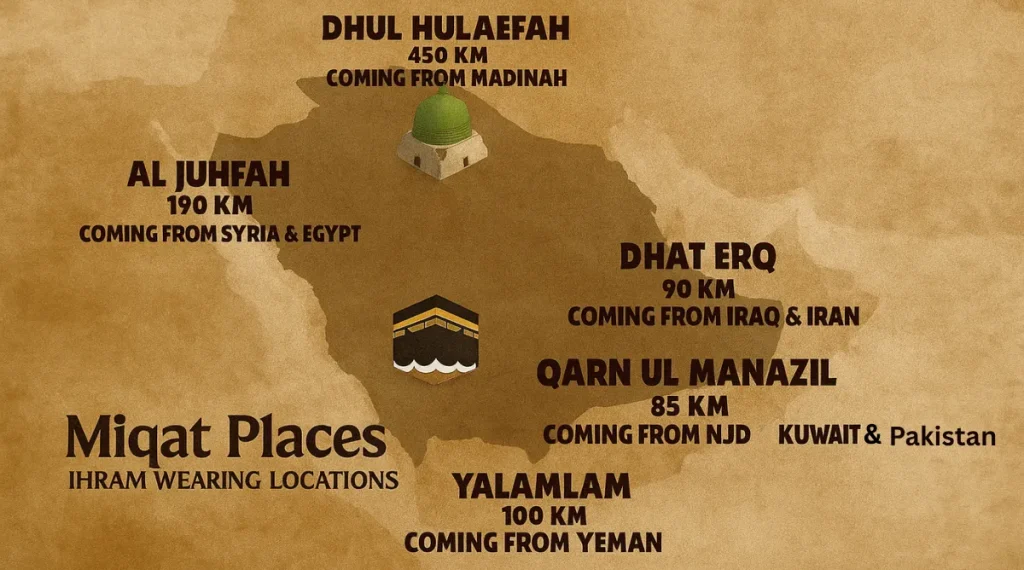
Map Of Miqat
The Five Miqat Locations: Your Spiritual Checkpoints
There are five main Miqat points surrounding Makkah, each serving pilgrims from different geographical directions. Let’s break them down:
| Miqat Name | Distance from Makkah | Direction | Serves Pilgrims From |
| Dhul Hulayfah (Abyar Ali) | 450 km | North | Madinah, Northern routes |
| Al-Juhfah (Rabigh) | 183 km | Northwest | Syria, Egypt, Europe, North America |
| Qarn al-Manazil (As-Sayl al-Kabir) | 75-85 km | East | Pakistan, UAE, India, Malaysia |
| Yalamlam (Sa’diyyah) | 92-100 km | Southeast | Yemen, South Asia (sea route) |
| Dhat Irq | 94 km | Northeast | Iraq, Iran, China |
Dhul Hulayfah (Abyar Ali)
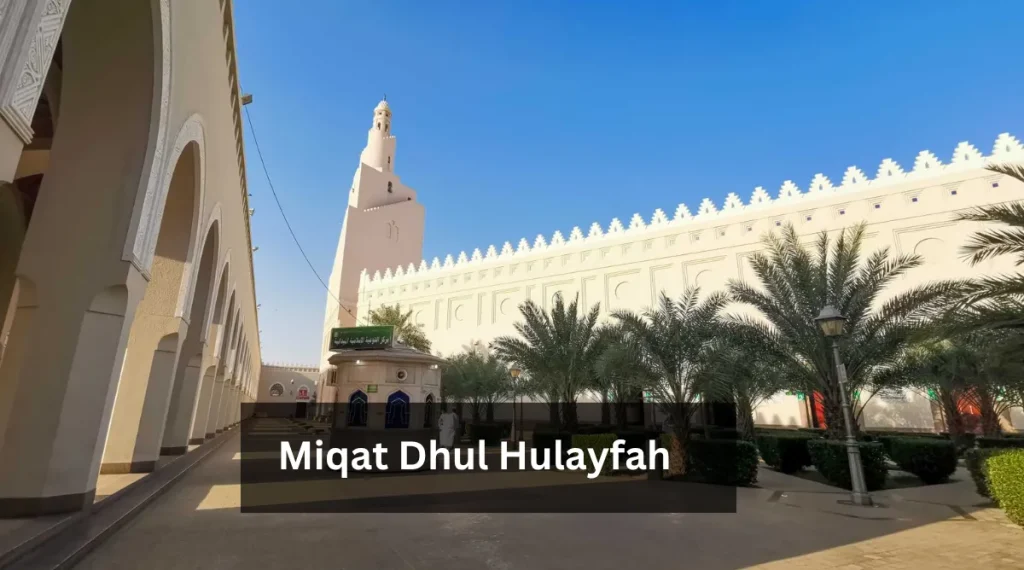
This is the farthest Miqat from Makkah at 450 kilometers north. Located about 10 km from Masjid al-Nabawi in Madinah, this is where Prophet Muhammad (PBUH) began his Farewell Pilgrimage. Today, there’s a beautiful mosque here called Masjid al-Shajarah where pilgrims can perform Ghusl and assume Ihram.
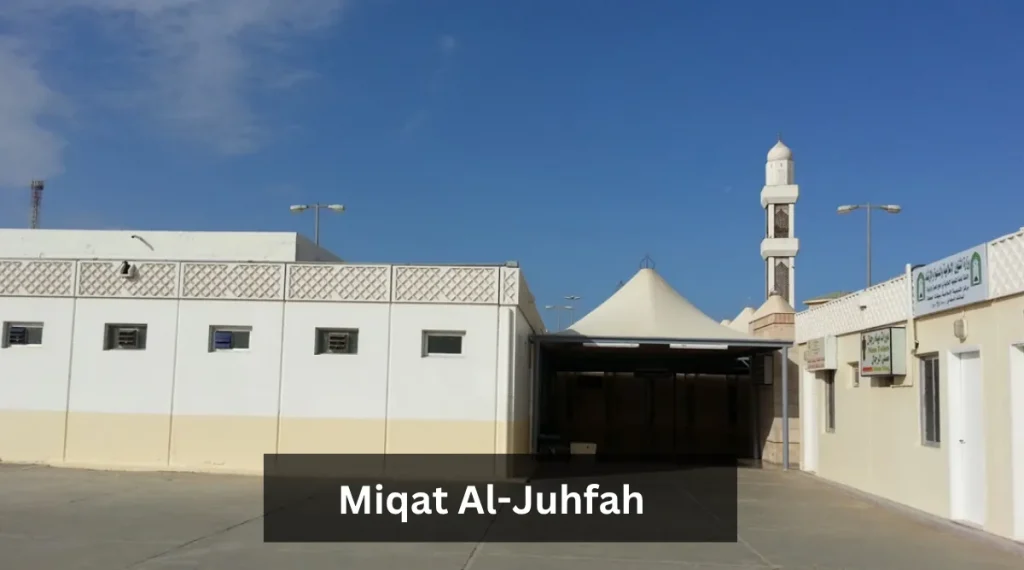
Al-Juhfah (Rabigh)
Situated 183 km northwest of Makkah, this Miqat serves pilgrims from Syria, Egypt, Europe, and North America. The original location of Al-Juhfah is no longer in use; pilgrims now assume Ihram at the nearby town of Rabigh.
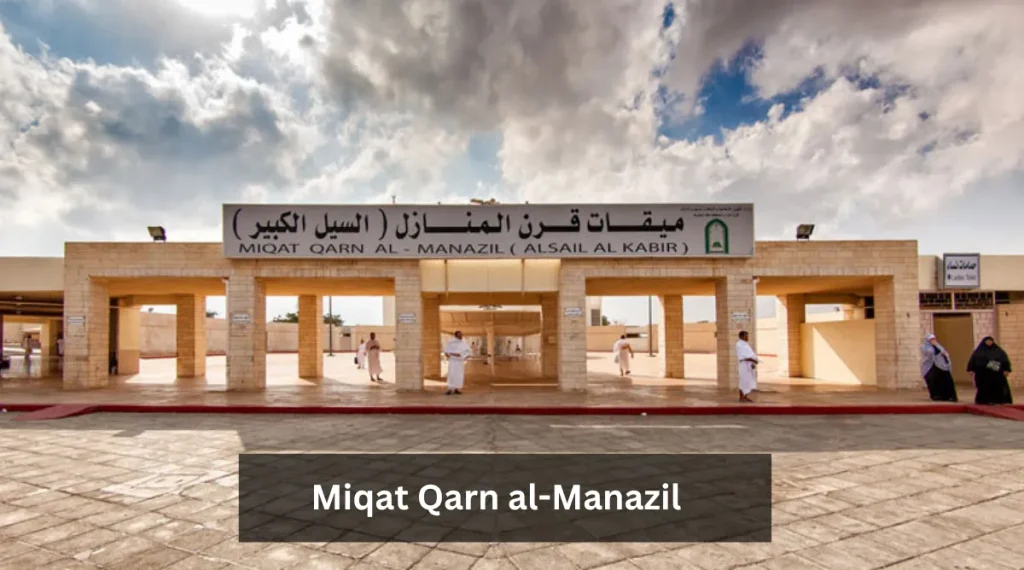
Qarn al-Manazil (As-Sayl al-Kabir)
This is YOUR Miqat if you’re flying from Pakistan! Located only 75-85 km east of Makkah, this is the closest Miqat to the holy city. It serves pilgrims from Najd (central Saudi Arabia), as well as those coming from Pakistan, India, UAE, Kuwait, Oman, Malaysia, Singapore, and Australia.
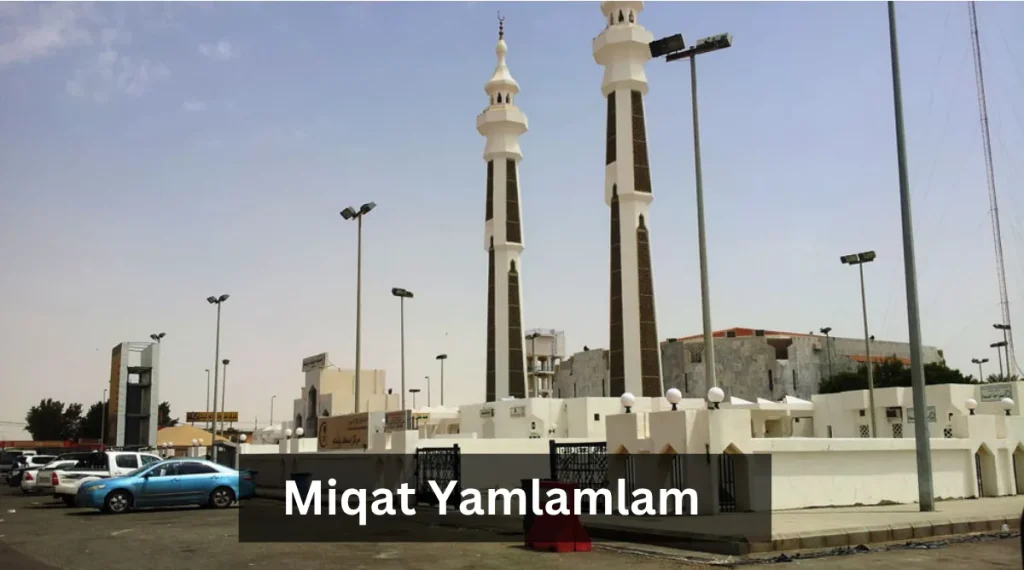
Yalamlam (Sa’diyyah)
Located 92-100 km southeast of Makkah, this Miqat historically served pilgrims from Yemen and those traveling by sea from South Asia. Some Pakistani pilgrims traveling via certain southern routes may cross this Miqat.
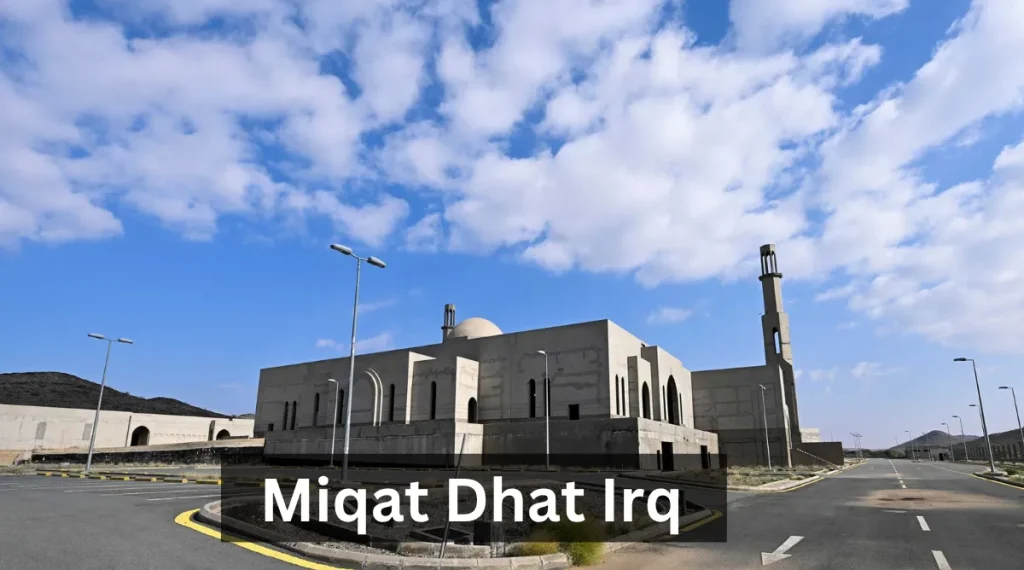
Dhat Irq
Positioned 94 km northeast of Makkah, this was established by Umar ibn Khattab (RA) for pilgrims from Iraq and Persia. It’s less commonly used today.
Miqat Locations for Pakistani Travelers: Which One is Yours?
Now here’s the million-rupee question: Which Miqat applies to you as a Pakistani traveler?
Route 1: Pakistan → Jeddah (Direct Flight)
Your Miqat: Qarn al-Manazil (As-Sayl al-Kabir)
This is the most common route for Pakistani pilgrims. Whether you’re flying from:
- Jinnah International Airport, Karachi (KHI)
- Allama Iqbal International Airport, Lahore (LHE)
- Islamabad International Airport (ISB)
…you’ll cross the Qarn al-Manazil Miqat during your flight, typically 30-45 minutes before landing in Jeddah.
What happens: The pilot will announce, “We are now approaching the Miqat boundary.” This is your cue to make your intention (Niyyah) and begin reciting the Talbiyah.
Route 2: Pakistan → Madinah (Direct Flight)
Your Miqat: Dhul Hulayfah (Abyar Ali)
If you’re visiting Madinah first before going to Makkah, you’ll cross Dhul Hulayfah. You have two options:
- Wear Ihram at your hotel in Madinah and make Niyyah when leaving for Makkah
- Stop at Masjid Dhul Hulayfah (Masjid al-Shajarah) on your way—most taxis and buses stop here
Route 3: Pakistan → Dubai/Doha → Jeddah
Your Miqat: Usually Qarn al-Manazil
If you’re connecting through Gulf cities like Dubai, Doha, or Abu Dhabi, you’ll still likely cross Qarn al-Manazil. However, some southern routes might pass Yalamlam. The airline will announce which Miqat you’re approaching.
CRITICAL WARNING: Jeddah Airport is NOT a Miqat!
This is the #1 mistake Pakistani pilgrims make, so pay close attention:
Do NOT assume Ihram at Jeddah airport if you’re coming for Hajj or Umrah.
Here’s why: By the time you land in Jeddah, you’ve already crossed your designated Miqat (Qarn al-Manazil) during the flight. Jeddah is located in an area called Al-Hill (the zone between Miqat and Haram), which means you’re already past the checkpoint.
The consequence? You’ll need to sacrifice an animal (Damm), which costs approximately 500-700 Saudi Riyals and causes unnecessary guilt during your sacred journey.
The solution? Wear your Ihram at the airport in Pakistan or on the plane before crossing the Miqat. Simple!
Boundaries of Haram: Understanding the Sacred Zone
While Miqat is the outer boundary, there’s also an inner sacred zone called the Haram. The Haram is the area within which certain acts are prohibited that might be permissible elsewhere.
The Six Haram Boundaries
| Boundary Point | Distance from Makkah | Direction/Road | Landmark |
| Taneem | 5-7.5 km | Toward Madinah | Masjid Aisha (Masjid Taneem) |
| Adaat Laban | 11 km | Road to Yemen | Al-Nakhla Valley |
| Wadi Nakhla | 11 km | Road to Iraq | Wadi Nakhla |
| Arafat | 11 km | Road to Ta’if | Near Masjid Nimra |
| Ji’ranah | 14 km | Toward Ta’if | Masjid al-Ji’ranah |
| Hudaibiyah | 16 km | Road to Jeddah | Masjid al-Hudaibiyah |
Within the Haram boundaries, it’s prohibited to:
- Hunt wild animals or birds
- Cut or damage trees and plants
- Carry weapons
- Fight or show aggression
- Pick up lost items without intending to return them
Understanding these boundaries becomes important if you want to perform multiple Umrahs or if you’re visiting Makkah for business purposes.
Understanding Al-Hill: The In-Between Zone
Al-Hill is the area between the Miqat boundaries and the Haram boundaries. Major cities in Al-Hill include Jeddah, Khulais, and Taneem.
Here’s what you need to know:
Scenario 1: Coming for Hajj/Umrah If your intention is pilgrimage, you MUST be in Ihram before entering Al-Hill (which means before crossing the Miqat).
Scenario 2: Coming for business or tourism If you’re visiting Jeddah for business or to see relatives, you don’t need Ihram. You can even visit Masjid al-Haram to pray without Ihram. However, if you later decide to perform Umrah, you must assume Ihram before entering the Haram boundary.
Example: A Pakistani businessman flies to Jeddah for meetings. He’s not in Ihram because his intention was business. After completing his work, he decides to do Umrah. He can now assume Ihram from his hotel in Jeddah before traveling to Makkah. This is permissible because his original intention wasn’t pilgrimage.
Miqat Etiquette: Preparing to Enter Ihram
When you reach your Miqat (or before, as recommended), here’s what you need to do:
Step 1: Perform Ghusl (Ritual Purification)
Ideally, perform Ghusl at home in Pakistan or at the airport before your flight. If that’s not possible, perform thorough Wudu (ablution).
Step 2: Wear Ihram Garments
For Men:
- Two white, seamless pieces of cloth
- Izar (lower cloth): Wraps around the waist to ankles
- Rida (upper cloth): Covers the upper body
- Use 4-6 safety pins to secure the cloth
- Wear simple sandals (no closed shoes)
- Head must remain uncovered
For Women:
- Any modest, loose-fitting clothing
- Full sleeves and ankle-length
- Can be any color (white is not mandatory)
- Headscarf (hijab) required
- Face must remain uncovered (unlike regular practice)
- Can wear socks and comfortable shoes
Step 3: Make Intention (Niyyah)
When approaching the Miqat, declare your intention:
For Umrah: “Allahumma inni uridu al-‘Umrah fa-yassirha li wa taqabbalha minni” (O Allah, I intend to perform Umrah, so make it easy for me and accept it from me)
For Hajj: “Allahumma inni uridu al-Hajj fa-yassirhu li wa taqabbalhu minni”
Step 4: Recite Talbiyah
After making your intention, begin reciting:
“Labbayka Allahumma labbayk, labbayka la sharika laka labbayk, innal-hamda wan-ni’mata laka wal-mulk, la sharika lak”
(Here I am, O Allah, here I am. Here I am, You have no partner, here I am. Indeed all praise, grace and sovereignty belong to You. You have no partner.)
Men: Recite loudly Women: Recite softly
When to Wear Ihram: Timing is Everything
Here’s the golden rule: Wear Ihram BEFORE crossing the Miqat, not after.
Option 1: At the Airport in Pakistan (HIGHLY RECOMMENDED)
Why this is best:
- Clean, comfortable facilities
- Prayer rooms available at all major Pakistani airports
- Can perform Ghusl properly
- Less stressful than changing on a plane
- Family can help you
- Time to adjust your Ihram garments properly
How to do it:
- Arrive 3-4 hours before your flight
- Complete check-in with regular clothes (easier)
- Go to the prayer room or bathroom
- Perform Ghusl or thorough Wudu
- Change into Ihram garments
- Pray 2 Rakah Nafl (recommended)
- Board the flight in Ihram
- Make Niyyah when the pilot announces Miqat approach
Option 2: On the Plane
If you must change on the plane:
Islamic Airlines (like Saudia):
- Have small prayer areas onboard
- Pilot will announce Miqat 20-30 minutes before
- Screen message: “We are approaching Miqat”
- Change quickly when announced
Non-Islamic Airlines (like Emirates):
- Limited facilities
- Small bathrooms
- No dedicated space
- More difficult but manageable
Pro tip: Keep your Ihram in your carry-on bag, easily accessible. NEVER pack it in checked baggage—you won’t be able to reach it during the flight!
Consequences of Not Wearing Ihram Before Miqat
Let’s say you made a mistake and crossed the Miqat without Ihram. What happens?
The Penalty: Damm (Animal Sacrifice)
What it involves:
- Sacrificing a sheep or goat
- Must be done within the Haram boundaries in Makkah
- Meat distributed to the poor
- Cost: Approximately 500-700 Saudi Riyals
If You Realize Immediately
Best option: Return to the Miqat location, assume Ihram properly, and continue. This avoids the penalty entirely. However, this is only practical for road travelers—if you’re on a plane, you obviously can’t turn around.
If You Cannot Return
- Assume Ihram immediately where you are
- Proceed with your Hajj or Umrah
- Arrange for Damm through your tour operator or local services in Makkah
- Seek Allah’s forgiveness
Prevention is better: Just wear your Ihram at the Pakistan airport, and you’ll never face this issue!
Ihram for Those Residing in Mecca
If you live in Makkah or are staying there after completing your first Umrah:
For Hajj: You can assume Ihram from your home in Makkah
For Umrah: You must go outside the Haram boundary (to places like Masjid Aisha in Taneem) to assume Ihram
This follows the practice of Aisha (RA), who was guided by Prophet Muhammad (PBUH) to assume Ihram from outside the Haram for her Umrah.
Ihram for Those Visiting for Business Purpose
This is an important distinction many Pakistani travelers miss:
If you’re coming to Jeddah or Makkah for business, tourism, or visiting relatives—NOT for Hajj or Umrah—you don’t need Ihram.
You can:
- Enter Makkah without Ihram
- Pray at Masjid al-Haram without Ihram
- Conduct your business normally
However: If you later decide to perform Umrah, you must assume Ihram. Since you’re already in Al-Hill (Jeddah) or the Haram (Makkah), you can:
- From Jeddah: Assume Ihram at your hotel before traveling to Makkah
- From Makkah: Go to the nearest boundary point (Masjid Aisha in Taneem)
The key is your original intention when you boarded the flight in Pakistan.
Miqat for Additional Umrah
Want to perform a second or third Umrah during your trip? Here’s how:
The Rule
You cannot assume Ihram from inside the Haram. You must:
- Exit the Haram boundary
- Assume Ihram outside
- Re-enter Makkah to perform Umrah
Most Popular Location: Masjid Aisha (Taneem)
Details:
- Located only 5-7 km from Masjid al-Haram
- Takes 15-20 minutes by taxi
- Modern mosque with separate sections for men and women
- Facilities for Wudu and changing
- Taxis readily available from the Haram
Why it’s popular:
- Closest boundary point
- Easy to access
- Well-maintained facilities
- Historical significance (named after Aisha RA)
Alternative: Ji’ranah
Located 14 km from Makkah, Ji’ranah is where Prophet Muhammad (PBUH) performed Umrah after the Battle of Hunayn. It’s less crowded but requires more travel time.
Important reminder: The Prophet (PBUH) never performed multiple Umrahs during a single journey. While permissible, focus on quality over quantity in your worship.
Tips for Pakistani Travelers
Plan Ahead:
- Know your Miqat location based on your flight route. Dhul Hulayfah and Qarn al-Manazil are most relevant to Pakistani pilgrims.
Wear Ihram Early:
- Consider wearing Ihram at the airport before your flight to avoid last-minute hassle during your journey.
Travel Comfortably:
- Ensure your Ihram garments and essentials (such as toiletries and medications) are ready before departure.
Stay Spiritually Prepared:
- Use the time before crossing the Miqat for prayer, Talbiyah recitation, and spiritual reflection.
Frequently Asked Questions
What are the Miqat points for Hajj and Umrah?
There are five main Miqat points: Dhul Hulayfah, Al-Juhfah, Qarn al-Manazil, Yalamlam, and Dhat Irq. Each is designated for different regions, ensuring that pilgrims enter the state of Ihram before proceeding to Makkah.
Can I wear Ihram at the airport before my flight?
Yes, it’s advisable to wear Ihram at the airport before departure. Many pilgrims choose to wear Ihram at the airport or during a stopover if traveling internationally. This helps to ensure you are in the correct state before reaching the Miqat.
Where can I perform additional Umrah during my trip?
For additional Umrah, you can wear Ihram from Masjid Aisha (Tan’im) or Ji’ranah outside the Haram boundary. These are common locations used by pilgrims wishing to perform multiple Umrah rites during their pilgrimage.
How long before reaching the Miqat should I wear Ihram?
You should wear Ihram before reaching the Miqat boundary. Pilgrims are often notified on their flights when they are approaching the Miqat. You should aim to be in Ihram by this point to ensure compliance.
What if I miss my Miqat and enter Makkah without Ihram?
If you miss the Miqat and enter Makkah without Ihram, you must either return to the Miqat location to wear Ihram or offer a Damm (animal sacrifice) as expiation for the mistake.
Can I enter Makkah for business purposes without wearing Ihram?
Yes, if you are in Makkah for business or non-pilgrimage purposes, you do not need to wear Ihram unless you intend to perform Umrah or Hajj. If you decide to perform Umrah, you must wear Ihram from a Miqat outside the Haram boundary.
Conclusion: Your Journey Begins at Miqat
Understanding Miqat and Ihram is essential for Pakistani pilgrims preparing for Hajj or Umrah. Ensuring that you enter Ihram at the correct Miqat will help you avoid penalties and ensure a smooth and spiritually fulfilling pilgrimage. Plan ahead, stay spiritually prepared, and embrace the sanctity of Ihram as you embark on this blessed journey.
Now that you understand Miqat and Ihram, you’re ready to plan your trip! Whether you’re looking for an Umrah package 2025 or planning ahead with Umrah packages 2026, make sure to choose a package that includes:
May Allah accept your pilgrimage, forgive your sins, and grant you a safe journey. Labbay Allahumma Labbayk!